11/26/10

SHOW

Once Upon a Time in White River
Commemorating Sixteen Days of Activism Against Women and Child Abuse

A South American poet and political commentator made it explicitly clear that he wants nothing to do with lyricism that has nothing to do with liberation. He was to a certain extent right – often lyricism for the sake of rhyming sucks. It sucks because artists spend countless hours yepping about themselves and how they are the dopest in the business. Well, I have been to plenty sessions but I can’t tell if there is what we call a dope poet. What I know is a poet whose is spot-on. Maybe we can call them a spot-on poet.
Spot-on means the bard touches on issues we all relate to. They produce material about situations we can all relate to – love, death, funerals, loss, pain, happiness, lust, weddings, trauma etc. They write about emotion and not daffodils which are an existing subject.

Maybe I’m trying to sound all-knowing but it’s my take – my opinion which I am entitled to, which if someone wanted to rob me of this right and you were aware of it you should give your life to protect it.
Well, the reason I am so chaffed is because I am still in a post-orgasmic stage of one of the best poetry, music and drama sessions I have ever attended. Our 16 Days of Activism against Women and Child Abuse jol at White River Civic Centre which brought together talents from Xpressions Sessions (Kriel), Bana Ba Bongi (Shatale), hip hop and rap crews from Madjembeni and some poets from other parts of the province. We had the best music, drama and poetry session under one roof – and did everybody pull up their socks?
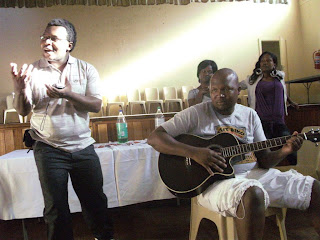
The thing about fusing genres to make a potpourri of a festival is that nobody wants to be left behind. You don’t get actors wanting the show to be remembered for its poetry, poets don’t want the show to be remembered for the drama and musicians don’t want it to be remembered for poetry and drama. Right there you have a recipe for subtle competition. However on the day that we committed to Chant Down Fear and give voices to our woman it was to a larger extent collaborative. If you can’t beat them, join them, they say. If you can’t play a guitar or drums, sing or recite to them, if you can’t sing or recite, play an instrument, just don’t stand there and look at us as if we are in a zoo.
I don’t want to mention names of performers on this post because I might not remember others and that might be fertile ground for animosity. However I will touch broadly on what transpired and what had me inspired to rush home, draft this post regardless of being bushed and blog it within 24 hours.
The themes touched on the day involved woman and child abuse, though I must admit there was actually little heard on the abuse of the child. A sister touched on identity – the so-called cross-cultural frustration of Coloureds. The Coloured issue is a human rights issue – it’s a pencil-test issue. An issue that will refuse to disappear from our consciousness as long as we focus on differences and not similarities. Her style, which was both at-your-face and an
indictment on society’s obsession with defining something they are not was crude and telling.

Well, it was at this session that what was saddening on my part was to have a show in White River and not have a single artist who performed in isiSwati. All the isiSwati artists invited to grace the event and be part of a horde of artists united in their defence of women and children’s rights failed to pitch – except of course for Comrade Sifiso. But now, when you have been in this game as long as some of us you know that it’s not the poet that makes the poetry session, it’s the poetry – which was in abundance in various languages.
What was refreshing was the liberty people expressed to speak – in the language of their ancestors and dreams. They spoke in Sepulana, Sepedi, Tsotsitaal (not Scamtho), Afrikaans and English. Like I said earlier what was missing was isiSwati and for god’s sake this is isiSwati territory. Either they are not writing anything that has anything to do with liberation, they are obsessing with the Metro Awards which are coming soon to this town or they just don’t give a damn about women and child abuse. To have the whole ethnic group not giving a damn is scary. It makes one wonder why we had this session in White River when we could have had it in Kriel or Bushbuckridge where almost all the artists who performed came from.
It makes one wonder about the future of the oppressed people of Swaziland? Who will liberate them if not by their kinsmen and women in Mpumalanga? If one can not commit to a simple cause that does not carry a prison sentence as a battle against patriarchy and its manifestations one wonders how many are willing to put their lives on the line on a cause that might require martyrdom.

Okay, enough of asking question and now it’s time for what happened. Bana Ba Bongi, that troupe of inspired children I love so much didn’t disappoint. They prepared a show specifically for the event and did they act like there was no tomorrow. No prizes for guessing that when the curtain fell they got a standing ovation – not because they are young and need motivation, but simply because they kicked butt.
We had an inspiration talk from GRIP, the project that has committed all its resources to the fight against rape and women abuse in the Lowveld. Sister Nomshado, one of two people I will mention by name gave a thought-provoking address about abuse. It was refreshing to note that she focused a large section of her address to the people who matter – the kids. She spoke in a language they found penetrating and frank.
Then there was motivational speaker and ex-activist (by her own confession) Matshilo Motsei. Known for penning the controversial book on Jacob Zuma’s trial (The Kanga and the Kangaroo Court) she rendered an item about the shifting power dynamics. As if prophesying, she said society is getting used to the fact that men are gradually losing their dominance and paving a way for a layer of power-women.
Well, at the end of all the celebrations it was time to exchange numbers and network. We would have loved a braai, but there’s always a next time. Some of the poets who graced the event will be revealed – warts and all in the upcoming Bantu Letters poetry anthology – coming in March. Malibongwe!


TO COMMENT ON THIS POST GO TO OUR FACEBOOK PAGE: THE Kasiekulture BLOG & write your comment on the wall

11/23/10


TO COMMENT ON THIS POST GO TO OUR FACEBOOK PAGE: THE Kasiekulture BLOG & write your comment on the wall

11/21/10

REVIEW

A moment of solitude with Imprendehora

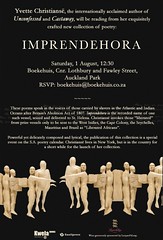
Yvette Christianse’s poetry collection Imprendehora is written in rich English which makes it a lucid source of indulgence. The only disjointer [the weak point] is the scattered approach to her writing. Though while not advocating for a structuralism approach to literature some form of self-designed template do offer help in the navigation of an individual's. One need not want a compass and GPS to travel through a poet’s delivery.

The poems contained in this book lack a thread knitted with rick fabric to join them together and create a solid bond. Reading this beautiful poetry [which stand tall individually] feels like attempting to put together a picture puzzle. The poetry feels as if each piece stands alone. Now, that would have been a commendable strength at an open mike session. Often it’s not the book that lacks cohesion but some poems as well where one feels more than one theme is explored in a single poem. It becomes glaring in a poem titled nameless.

In February you start to feel that the poet’s muse is a collection of tragedies that happened at an island feared for its prison. St Helena is where French emperor Napoleon Bonaparte died in the 18th century and it has been notorious for its mystery.

The poem’s treatment of the subject of death and loss invites emotion and evokes feelings of the US South during slavery where being hung a lot was the order of the day. When people are lynched by night and are the first thing you see in the morning that sets the tone for how your whole day will be.

She continues on Abundance with the St Helena theme and while you feel this can be a workable approach to attracting attention Yvette drifts away in My Mother’s Hands. The one thing that stands out throughout the book is the poet’s obsession with a spider and its web, which’s frequent use comes across as a metaphor for life’s complications.

Books, whether fiction or non-fiction survive on making a lot of sense – and sense often comes from consistency with the message – something Yvette fails to stick to.

11/10/10

REVIEW

Counting Sleeping Beauties – A Review

Frankel’s novel had the potential to be a readable work of art if she chose a language and stuck to it. What was supposed to be the book’s strength, using multiple characters in their comfort zones is self-defeating in a country where plurality often means too much.

The author’s clever use of Yiddish to build her Jewish characters is a strong point, same as Zimbabwean authors would write about sadza and an Afrikaner about doek. It starts to annoy when the author attempts to make this book an International Language Board. Yiddish is good when used in limited quantities to highlight the influences of Jewish culture in countries such as South Afrika. It’s refreshing to read about Shabbos and Barmitzvah but gets to your nerves when you get whole sentences in Yiddish. The author’s flow is also dampened by the absence of clearly-defined chapters in the book.

It might have been a problem of design and layout but chapter definitions always remind the reader to pause and reflect. Her flirtation with Sepedi also exposes flaws since a character in a book should speak their mother tongue of good quality. Such can not be said about her Setswana while her Afrikaans has a nice ring to it – it still comes across as pidgin.

Frankel has a way of building and then bringing down without warning. It makes following her throughout the book difficult. While one relishes surfacing Gertrude from Pietersburg at irregular intervals it is her first person approach to the narrative that weakens this book. It would have been perfect if it was narrated on second person throughout.

The book attempts to enhance social cohesion and building the nation. However I fail to understand why it must always be done at the expense of the black domestic worker? Black women are portrayed as nothing but domestic workers and prostitutes. For me, this silicone addressing of South Afrika’s racism in the 1950s and 60s is patronizing.

I find this book to be full of innovation but lacking in creativity. The only ounce of creativity that is glaring is the fact that a story set in Joburg in the 50s was conceived and written. The writing is impeccable, especially in the year 2000 section of the book where similarity leads to relativity. For a domestic dying alone and a father dying surrounded by family – it’s vintage 2010 South Afrika, warts and all.

TO COMMENT ON THIS POST GO TO OUR FACEBOOK PAGE: THE Kasiekulture BLOG & write your comment on the wall

11/8/10

REVIEW

Sex Work Explored – Warts and All

Shameless explores the power of dreams and the triumph of the human spirit. It rather says there’s no hopeless position, there’s just hopeless people. It takes the issue of morality and give it a human face. Futhi’s narrative is no-holds barred and has the capacity to disturb an inquisitive mind.

The book is written in a linguistic style that is so obvious that the author is confortable with. It is rich in imagery without drifting towards being a badly-scripted documentary. She engages with the subject in a manner that humanizes it while at the same time fighting a societal temptation to be subjective. One of the challenges of writing about tired themes is to interplore existing related vocabulary and use of cliché nouns. Futhi manages to shy away from that. The flow is documentary-like, like the documentary being shot – but the delivery is punchy.

The issue of sex working has been exhausted to the bone in films, documentaries and individual interviews. Anyone wanting to revisit this subject should find fresh angles of treatment. Unfortunately Futhi does not succeed in this regard. And the feel-good ending could have done will with a twist in the tail. Feel-good stories are for Sunday school, which makes Futhis’ book a great contender to partner the Gideon’s yellow.

It is not a South Afrikan story but a universal one. Futhi missed an opportunity to give her story a local identity. The only thing South African about it is the location and the names of the characters. Anything out of that it could easily happen in Maputo. Transcending time? We need to understand here that Futhi writes about the oldest profession on earth and to balance morality and cohesion is like trying to suppress consensus amongst five differing groups. However her undertaking to tell this sad story with a happy ending goes some distance towards nation building.

She’s undoubtedly creative and her storytelling skills are impeccable. Futhi just needs t find a subject she is comfortable with and apply her skills on it. She blends different genres very well, when you think it sounds autobiographical you notice that it is a biography of a sex worker without the author’s alter-ego/character giving much about self.


TO COMMENT ON THIS POST GO TO OUR FACEBOOK PAGE: THE Kasiekulture BLOG & write your comment on the wall

11/7/10

REVIEW

An Abridged Letter From Paris -Eric Miyeni's book Review

While Eric Miyeni's travelogue is a beautifully written piece of literary journalism, if fails at crucial moments. It is a very strong narrative which exposes the author's good command of the English language and his flaws in an attempt to make sense of French, as a language (3/10). I believe that the score for language suggests that there is always room for improvement, given that this is not the author's mother tongue. The editing of this book is brilliant and has put an extra coat on the vocabulary flaws that even without the benefit of having seen the draft, would have been glaring.

Notably, writing about a city is a difficult undertaking since it's one take of a well-known fixed subject. So, to believe that Miyeni's book is based only on-location observation and answers generated during conversations would be a disservice to this genre. Accuracy of some information seels off the fact that he must have spent sizeable time doing research both here and in France. So, on that aspect, it is informed nto only by his visit to Paris but what others have already written on the subject before.

The form is not consistent as at times one is lost to the possibility that the text is informed by pictures or vice versa. While he makes it flow it is that question about why some pictures are there that make it an attempt at a photographic book with commentary. This is not a book about amateur photography but is sold as a photographic book with text. The photographs would have been excellent if there was an artistic touch to them. It makes no sense of the author touching a lot on the issue of red jackets while nobody sees such. It's pointless to title a picture 'Another red jacket' (pg 71) while the reader sees black. His touch of French art, architecture and culture is obviously informed by the Piper.

It has an appeal, not only South African but universal as well. It reminds one of the writings of Bongani Madondo. The truth is that one needs to fall in love with a subject before they can do justice to its aesthetic. Miyeni fell in love with Paris, but as he told a South Afrikan newspaper, he doesn't do poverty tours, which means he deliberately opted to present a distorted picture of Paris. For a man who protested doing poverty tours one wonders why Queer tours were a marvel.

I would protest that Miyeni's book enhances any social cohesion due to his uninformed comparison of the suffering of Afrikan slaves during the Passage, Blacks under Apartheid and the Holocaust. For the book to make a claim that the Holocaust was worse simply because the victims have been documented is absurd. Pain is not a comparative feeling/emotion. The small plaque (pg 52) at what used to be the border into Ciskei of people butchered during the attempted takeover of the bantustan by the SACP/ANC group spark the same saddening one feels at Matola (Mozambique0 and the Apartheid Museum. I think to elevate Jewish pain above that of other races is the drawback of this travelogue's attempt at social cohesion.

The creativity in this book is stumped by lack of colour, though minimal I would still rasie the issue of sub-titling a picture which tells a different story. A picture is a storyteller and any attempt to play proxy must be informed. I believe the arrangement does not flow. Dotting a map of Paris would have produced Miyeni's wild goose chase through a city he chose not to explore.

The voice he chooses to narrate is loud, sometimes too loud to accommodate subjects he introduces us to whose voice he wants us to hear. Thus, Miyeni could remedy by not appearing to be all-knowing. He's got excellent writing skills that are often dwarfed by his ego which he massages at every turn.

His level of analysis leaves a lot to be desired. Most is informed by secondary sources as with the artwork and architecture. He however makes a strong socio-political point about preservation of landmark sites such as Kapitans in Johannesburg (pg 77). However his level of criticism can be allocated 5/10 points. Miyeni is irked by a club brawl that degenerates into a street fight and his response is on point as he raises the issue of zero police visibility, a complaint Europeans would make about countries such as South Afrika. His review of the subject matter is quite brilliant but often the language creates a barrier as any tool of mass communication should shy away from techno-speak and jargon.

The author tries to be objective - but the Piper has other ideas.

TO COMMENT ON THIS POST GO TO OUR FACEBOOK PAGE: THE Kasiekulture BLOG & write your comment on the wall

10/24/10

NEWS

Last Man Standing - Chickens Coming Home to Roost

As those who have had the joys of sex will tell you, the peak of that activity is the climax. That spasmodic giant boo-ya-ka, a real throwdown. Well, that is what I felt this week as the chicken finally came home to roost. The vampire I have been trying to see removed from the Blood Bank finally got its marching orders – Frank Segolatseleng Mogakane will no longer be part of the academic life of hundreds of learners who have had to endure maladministration, incompetence, nepotism and fraud. Ditau was a dysfunctional entity until I declared war everlasting against its deep-rooted culture of entitlement that saw learners becoming mothers because their teachers felt they were their fringe benefits. I came, I saw and said such free-for-all conduct must stop.

South African Democratic Teachers’ Union said it can’t ge done. They said that anybody trying to trample on the rights of their members will be met with their strong force. Well, that’s me – strong force versus me equals – well, nothing. Today I am the last man standing.

I am a patriot. I might not hang the national flag on my house or the mirror sock on my car. I wear my heart on my sleeve.

Recently controversial Ditau High School principal Moganake resigned. It came weeks after his suspension and charging with financial mismanagement by the department of education. Following a series of investigative articles in this blog which exposed alleged graft at the school the department finally suspend him on 06 October 2010.

No one knows if Mogakane was pushed or chose to jump, but indications are he might have jumped to save not his reputation but his retirement and pension funds.

Following his suspension School Governing Body chairperson Platus Mokoena said they welcomed move. Speaking to this blog last week Mokoena said the move to remove Mogakane was a vindication of the body’s pursuit for clean governance in the face of mounting political pressure to turn a blind eye.

“We have received calls from parents who are happy about developments. We are happy that he (Mogakane) has been removed from the school. His removal has contributed to stability since in his presence days were spent holding damage-control meetings as the teaching staff conspired to get rid of the SGB. Teaching has now stabilised”, Mokoena says.

Mokoena adds that it was time the department dug deeper and suspended more people as there were more educators involved in various misconduct. Without mentioning names Mokoena alludes to the fact that some of the financial mismanagement that drove Mogakane to jump before he was pushed couldn’t have been executed without co-operation from other teachers given that cheques are not signed by the principal alone.

He says even those alleged to be abusing learners should be investigated and removed. This blog can confirm that for some few years the second signatory to the school cheque was Mogakane’s younger brother’s best friend’s wife, an explicit conflict of interest.

Sources told us that cars from the department descended on Ditau weeks ago to issue Mogakane with his Notice of Suspension. “They wanted him to vacate the school immediately. He was sobbing and trying to negotiate the terms of his suspension”, a source revealed. On the day the political support he has received from heavyweights such as the Executive Mayor of Bushbuckridge and ANC regional chairperson Cllr Milton Moreme was nowhere to be found.

Unveiling a road project early this year Moreme told community members that the allegations against Mogakane were unfounded and were politically motivated. Mokoena said as an SGB they now feel vindicated in their pursuit of justice against union and political pressure.

Mogakane was earlier this year fingered in a dossier compiled by the SGB of mismanaging approximately hundreds of thousands of public funds meant for the school. A 23-page dossier spelt out how a school grant of R393961, 00 was allegedly spent in a space of two months. It decried the absence of a tariff policy to regulate travelling after the former principal claimed R57843, 00 in seven months.

The dossier alleged that bricks to build a guard house were bought for R58200, 00. A Kasiekulture Blog investigation of the brick type used at concluded that they retail for R2800, 00 per thousand.

He was also accused of appointing his younger brother, Lawrance Mogakane’s company to audit Ditau’s books, concealing massive fraud that could have been picked by a first year Accounting student in the process. Young Mogakane is the former Chief Financial Officer of Bohlabela District Municipality who was fired under a cloud five years ago.

“The department (of education) noted levels of mismanagement at the (Ditau) school following an investigation done by the internal audit. As such the principal was suspended, will appear before the departmental disciplinary committee in due course”, education spokesperson Jasper Zwane said last week before Mogakane resigned.

Zwane adds that, “the department conducts internal audits in schools, train SGBs on financial management and constantly monitor how funds are being managed”.

Concerned teachers at Lehlasedi High School have requested the department to investigate the disappearance of building material worth tens of thousands of rands at the school two years ago on the same day that it was delivered regardless of the presence of a security guard. No one has been arrested for the theft regardless of the SGB of the school being led by a police commissioner.

TO COMMENT ON THIS POST GO TO OUR FACEBOOK PAGE: THE Kasiekulture BLOG & write your comment on the wall

10/11/10

TRUE

From a Consumer to a Producer - The Tale of My Baby

Since I moved into my new place I have been fixing to go organic. Big time organic - eat greens, no chicken, no beef, no mutton no pork. Okay, my approach was to eat pork only if it's swinehead with my friends over cold beers. My analysis was that we could do this every once a month, only when Pirates is playing a big team. So, while I don't have any television in my house I figured while the matadors are chasing dead skin a thousand kilometres away we could be playing mind games. See, me and my boys don't just talk about women when we are chilling.
So, back to my organic ambitions. Of all the first things I planned to do, which included cultivating a beautiful garden was to grow weed. First, my ambition was that feeling of misdemeanour. I wanted to look suspiciously at cops as they drive by. It's always worth your life to be up to something illicit - stimulates your toes. I know how if feels when I hack into some people's email addresses searching for evidence of infidelity - it feels good and it's only anti-climax when I don't find what I suspected to be there.

So, I wanted to grow marijuana on my garden, and maybe one day when I have that terrible headache I would harvest a handful, dry in humid conditions and roll in Rizla to make myself a fat spliff. Maybe chill in a brand-new Benz with my ID (thanks to the Teflon Don) and cause an environmental harzard. However, that was somewhere in the back of my mind.

Then, some time last year one of my weedhead friends popped in with some nice grass that got him seriously goofy. After he sparked a fat cone he was out and left me the left-overs. I gingerly gathered the dust (it wasn't magic - I noticed) and splashed it on my garden to stimulate the soil. I was also hoping that it could grow and beautify my garden. I also felt that with hash in my garden all them damn demons will find landing a stress.

A week later there was nothing. A month later there was nothing and I started stressing. What the fuck does weed need to grow? I remember it grew without permission in my flower pot twelve years ago after just a single seed was thrown there. I culled it when my grans started looking at me suspiciously. I knew if I got arrested she would have said 'he's my grandson, finish and klaar. Plus these hands are clean', hahaha.

So, with no weed from my friend I enlisted the services of one of my she-friends who brought me a carefully rolled spliff and some seeds. She dropped them on the next flower complex. Two weeks later she pitched with some fresh weed but the plantation was still begging. I complained and she adviced me to look the other way and not stress the process. But woman I want the muthafucka to grow before the rains start so that I can grow something to conceal its beauty.

Then a beautiful woman - one of the intelligent few I have since come to know closer came by my crib the other day. We had an hour long session whereby I picked her brain like an early bird catching the fattest worm. When she was leaving I once again complained to her about the apathy that weed was showing towards my garden. She adviced patience. A week after that visit, which I should confess left me feeling very important indeed I saw my five-leafer raising its head. I felt, aha, I'm on my way from graduating from being a consumer to a producer. I am nursing my baby-weed as if it was a comatose patient on life support. Next time i post a picture of my baby-weed. Once it's up and growing, I move to full-organic and make vegetarians happy - hahaha

TO COMMENT ON THIS POST GO TO OUR FACEBOOK PAGE: THE Kasiekulture BLOG & write your comment on the wall

10/3/10

REVIEW

Ethekwini Will Never be the same Again – thanks to Bana ba Bongi

So, the last time I blogged about the drama troupe I have so much confidence in, Bana Ba Bongi was before they sojourned to Ethekwini for their overdue initiation into the world of thespians at The Playhouse. In Sepedi they say, ‘le kobja le sale meetse, ge le ka oma le ya hlaba’. Well, this is one of those proverbs without an English translation – however if I have to try it says that clay can be molded into anything only while wet.

So, with these kids that’s exactly what community builders and committed teachers Nkoto Malebye and Zakhona Mogane are doing – catching them young like sardines. The brains of these kids are still at that stage where anything can be inculcated and made to stick. That’s the same age Hitler Youth were introduced to a doctrine of hate.

The first time I saw Baba ba Bongi stage a show was their inaugural performance infront of their parents and invited guests at Narishe Primary School. You could see that they were still pretty rough in the edges while the hunger for knowledge was disarming. However roughness is romantic when it’s on a diamond. It means that the value of the stone is still locked – is it 9, 18 or more carats? Or maybe it’s the elusive blue diamond.

So, I am reliably informed that the kids went to Ethekwini and had a ball. The last time I had a conversation with Nkoto I gathered that while it should be an educational trip for the young thespians it should also open the world for them. They need to have fun. They need to know that there’s a body of salty water called sea which does not swallow people as legend has it. They need to interact with like-minded people in the industry. They need to be told by someone they respect – probably someone they might have seen on television such as Nthati Moshesh or Sello Maake ka Ncube that they have potential.

Well, that’s a story for another day. That’s still to happen I reckon. They’ll still meet lots of them in the future. However I am told that they went to Ethekwini, had two performances, went out, attended shows, went to the art gallery, went to the Bat Centre, Moses Mabhida Stadium, the beach and various other spots in Ethekwini that a tourist from inland would like to visit.

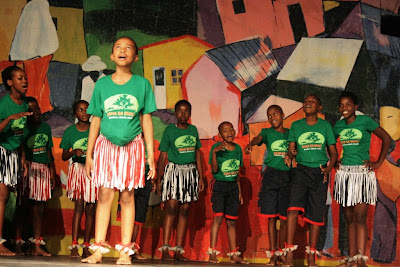
They went there and had fun. The snapshots, which we are taking a please of sharing with you show a bunch of naïve children smiling at every frame. Happiness was indeed the theme. You felt you could freeze their little smiles and their optimism forever.

Now back home they shared with their parents what they showed the world. It was my second time seeing these confident kids perform and I was humbled. I wasn’t humbled because they are local kids. I was humbled because I have seen people perform and bowl the world – however I have never seen people this young do it with so much commitment that the following day I told Nkoto and Zakhona that I pray that the pedophiles in our community do not derail them.

I believe these kids deserve all the love, care, attention and altruistic spirit they can get from their teachers and society at large. They need to look at older males and see their brothers, uncles and fathers and not perverts out to give them babies and HIV.

I felt sad because there is no place called careful where we could just take these young talents and groom them far from prying lusty eyes.

That aside, I could put my dime that while millions will be called and a few chosen; if these kids continue at this pace millions might be called and millions chosen. They deserve all the success in the world. The world is their oyster – Shakespeare would have said.


TO COMMENT ON THIS POST GO TO OUR FACEBOOK PAGE: THE Kasiekulture BLOG & write your comment on the wall