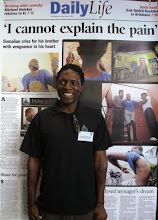
Curtain Call - Moses Seletisha

The
late Professor Es’kia Mphahlele believed the silver lining apartheid provided
was it allowing indigenous languages to flourish through investment in their
development. This was not the case in other parts of colonial Africa.
In
a post-apartheid South Africa there are complaints from language practitioners
that the democratic government has little regard for Black languages. “I
have seen groups growing and dying of hunger. It is the Department of Arts and
Torture that is not doing us right at times. They will always tell you there is
no sufficient budget”.
Sepedi
performance poet, playwright, actor, translator, writer and intellectual with a
keen interest in African languages Moses Seletisha (27) protests.
He
is one of a growing number of young artists who choose to express themselves in
their mother tongue because as he says, “why do you want me to speak your
language when I have mine?”
Seletisha
was born at Mooihoek Village in Tsimanyane. He grew up in Leeufontein next to
Marble Hall in Limpopo Province. By his confession
his father passed on when he was five-years-old, leaving his mother to raise
him, a brother and sister with her R500 a month wages. He remembers that his
father worked in the mines and alleges his pension was squandered by his uncle.
As a result he was raised by his grandparents Martha and Stephen Seletisha with
whom he still lives.
His
first literary awakening came when he was recruited by a theatre company. From
here his formative stage mirrors that of most Limpopo artists. “During Heritage
month I saw myself reciting my first poem ‘The
University of The North’ which was a dedication to the late Prof. John
Ruganda organised by University of Limpopo. The reception was too overwhelming
and made me escalate my pen. At the same time I was serving as an actor
performing at The Market Theatre Lab and National Arts Festival (Grahamstown)”
Seletisha
prides himself on being ‘an old lion’. “My pen started making sense at
the age of fifteen “
he says. However, for a 27-years old man who models himself after the doyens of
Sepedi literature O.K. Matsepe and N.S Puleng it seems Seletisha is comfortable
with not getting much attention. He has shared the stage as a poet with notable
voices such as Vonani Bila, Lois Reeds, Lesego Rampolokeng, David Wa
Maahlamela, Matete Motsoaledi, Mmatshilo Motsei, Antonio Lyons and many
others. “If it was not of poetry I would
have become a murderer, I use it for verbal masturbation”, he confesses.
It
however is not poetry that pays the bills in the Seletisha household. Stage is
what he is known and famed for; often
wowing crowds across provinces with his animated presence. He has been an
artist for the better part of his adult life where he acquired experience
working in different stage productions such as Kgorong (The Royal Court), Le kae letsoalo, Khupamarama (The Secret),
Swana ya Mosate and The Way.
The big project of this
prolific English to Sepedi translator is Tšhutšhumakgala
(Coal-train). Tšhutšhumakgala is the
biography of Frans Tlokwe Maserumule, a former Umkhonto we Sizwe combatant who
is now a member of parliament. “A first black prisoner on Robben Island to get married
in Pollsmoor Prison during the apartheid system. He was granted a 10-seconds
honeymoon. Tlokwe is an unacknowledged hero of the liberation struggle in this country.” he says.
Seletisha believes through this book Tlokwe, who still has bullets lodged in
his body will finally be honoured.
The
biography is edited by Motsoaledi and wa Maahlamela, both of whom Seletisha
calls “my gods of poetry”. Foreword is by former APLA commander Letlapa
Mphahlele.
He
swears by Bila. “He is one honest writer, his work contains the truth.”
Himself,
wa Maahlamela and Motsoaledi are the trio responsible for the renaissance of a
language that is endangered by the emerging middle class which prefers foreign
to native. Seletisha is optimistic, “The upcoming generation will also donate
the tongues to add on the spice. Instead of investing in sex, alcohol and human
trafficking, crime and all unprofitable activities.”
TO COMMENT ON THIS POST GO TO OUR FACEBOOK PAGE: THE Kasiekulture BLOG & write your comment on the wall