Showing posts with label steve bantu biko. Show all posts

2/14/11

REVIEW

I Eat Sushi Where I Like – Revisiting Steve Biko
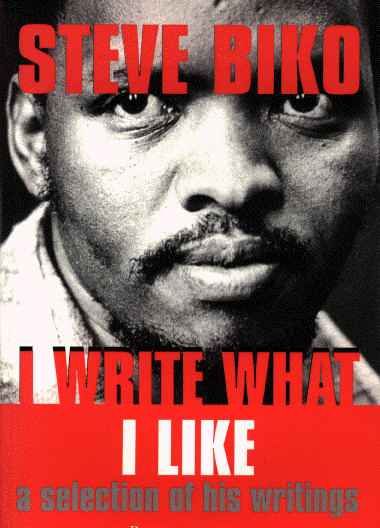


Steve Bantu Biko came way ahead of his time – when one analyses what has been happening in this country in recent history; the political Black on Black killings in Mpumalanga, the political literal back-stabbings in the Western Cape, the traction in COPE and the self-hate that has engulfed the Black middle class since 1994.

Maybe Biko came in time before the crass materialism and vulgarity of excess that characterises our democratic order could poison his altruistic spirit. We have seen great men drink from the fountain of greed and become beasts we never knew existed. I Write What I Like, a collection of his essays is still in need of a peer. Those who tried to undo the good work wrote dodgy capitalist encyclopaedias such as Capitalist Nigger (Chika Onyeani) and Architects of Poverty (Moeletsi Mbeki). Biko provided a benchmark at times bigger than his own influences such as Franz Fanon, W.E.B du Bois and Malcolm X. For anyone who has indulged Biko's nectar and those of his ilk it is undoubted that earlier nationalists and social scientists fed a lot into his muse.

For a man who was as well-read as Biko the language deployed in articulating the role of Black people in apartheid South Afrika is lucid. It's often contrary to what modern intellectuals, often communists resort to; of using verbose language that tends to lose the reader even thought the aim of any written word is to be read. Biko's simplicity is difficult to understand given that the late ‘60s and seventies were characterised by a proliferation of revolutionaries as Harold MacMillan’s winds of change were sweeping not only Africa but Latin America and the Middle East. With Palestinians, Sandinistas, Che Guevaras and Ayatollahs (bubbling under) all in their element, Biko crafted his message to speak to Black South Afrikans but with a solidarity theme that would have inspired Palestinians in a refugee camp to continue fighting.

It is a message of universal self-love rather than pan-Africanism. It’s not Black consciousness for the sake of social expediency but also to hand over humanity to an oppressor. Biko noticed that the oppressor was also a victim of their sense of self-importance. He spoke to them in a language they were comfortable using against Blacks. He realised that all oppressors the world over needed was to be brought back to mother earth and admit that they were not the most intelligent folks simply because they were born 'white'. "No race has a monopoly to wisdom", an earlier philosopher echoed.

The literary merit of Biko's work is unquestionable to the extent that it beats me why do we have Durban University of Technology Steve Biko Campus and Memorial Hospital while this book; which should be prescribed for all school grades; from eight to 12 is in the fringes. I still have to see an indigenous language translation of this book sponsored by the Language Board. I still need to see one essay used during the Grade 12 examinations. To navigate the future in harmony both Black and white children need to find themselves between the pages of this beautiful narrative. There's nowhere in the book where Biko says, 'fuck white people. I hate white people. I detest white people'

Nation-building needs not denote shying away from peeling scabs to expose the pus and clean the wound but to be able to prescribe amputation if it’s the best solution. South Afrika has a lot of septic wounds that need attention. Like chemotherapy it will hurt to some white people but one rather live without a bad tooth than to endure unnecessary pain caused by a dying doctrine. Apartheid, in Biko's mind was never really feasible; sad that it took Boers so long to notice that.

Biko didn’t need to be creative like artists as this book is made up of essays and letters he wrote for the consumption of different people. However in his twenties Biko had enough brain cells in his head to put to shame some 40-years old (who loves eating sushi ontop of naked women) who would write long diatribes to respond to Biko saying, “material want is bad enough; coupled with spiritual poverty it kills” [page 30]. I hope Kenny Kunene reads; not only this post but Biko's book as well.


TO COMMENT ON THIS POST GO TO OUR FACEBOOK PAGE: THE Kasiekulture BLOG & write your comment on the wall

8/27/07

LEGACY

REMEMBERING (AND UNDERSTANDING) BIKO
September, whether someone likes it or not is Steven Bantu Biko month. While we should live his legacy everyday, it's at times like these that we get a chance to reflect on this torch extinguished so early by the forces of darkness
Five years ago around this time I was one of the few critical opinion-makers invited to the BUWA African Languages and Literature into the 21st Century, an African Renaissance Initiative of the Native Club conference held in Tshwane. The aim of the meeting was to give birth to an African ideal for an integrated collective African thinking which will take into consideration contributions from the Diaspora and from who Dr Martin Luther King called "our white brothers, as evidenced by their presence here (here today"

Just so you should know some of the dignitaries who attended and contributed worthy papers and direction were celebrated author and pure-afrikan Professor Ngugi wa Thiong'o, Professor Charles Cantalupo who is professor of English and Comparative Literature at Pennsylvania State University in the USA, Andries Oliphant (UNISA), Prof Mbulelo Mzamane, Prof Taban Lo Liyong and many other think tanks who are equally influential in their fields of literature. Also visibly present was intellectual and current head honcho at the Human Sciences Research Council Dr Xolela Mangcu.

We met to interrogate different ways to position African languages to a point where they can be as popular and standardized as Mandarin, Spanish, English, and Latin before it. Incidentally, the intellectual gathering coincided with the commemoration for the martyrdom of black consciousness torchbearer and most celebrated voice of his generation and beyond,
Steven Bantubonke Biko.

A lecture was held at Wits University, conducted by wa Thiong'o and facilitated by the Steve Biko Foundation, Also understandably present was the highly effective team of Mangcu and Nkosinathi Biko.
Samora and Nkosinathi Biko (pictured)
Two days later at a glittering banquet held at the Presidential Guest House in Tshwane graced by then deputy Minister of Arts and Culture Buyelwa Sonjica, ICASA's Mandla Langa, Dr Itumeleng Mosala among others, wa Thiong'o and poet laureate Sonja Sanchez were honoured. During the function and speeches the name of Biko was left in selective-amnesialand. The absence of its mention was annoying.

Nobody, of all the cream of African intelligentsia felt that Biko deserved special mention on the same congratulatory breath as wa Thiong'o and Sanchez. It was rather sister Sanchez who mentioned Biko's name once in a poem she rendered. Somebody was out to honour the two at the expense of Biko and to shift the focus of wa Thiong'o's visit to reflect that he was here as a guest of the government, which he was not.

Which brings me to one of the most stupid questions-statements ever uttered-asked by white South Africa, though not verbatim, was to question-say why the widow of the late Biko said she will never forgive the killers of her husband while Nelson Mandela forgave. "Who is Nontsikelelo Biko not to forgive while a man who spent 27 years in prison came out and forgave?" the question-statement was asked-uttered.

Everybody is entitled to their grief. Pain is not homogenous and to compare Mandela's pain and his response to it to the rest of black South Africa should be criminal. Nobody should demand that black people forgive because Mandela did. Mandela did not forgive on behalf of black people but himself.

Biko's widow won't forgive, which apparently reflects the feelings of most black South Africans. She spoke for many South Africans, which is questionable if the same can be said about Mandela.

This is not going to be another billboard for Biko, a critiquing of his legacy for critiquing's sake or another promo of his memory but a serious interrogation of his role in South African history and an analysis of his impact on the lives of ordinary folks who find it hard to forgive.

The buzzword in the country right now is reconciliation with former Minister of Law and Order Mr Andrian Vlok having undergone his lap of comedy already. Forgiveness, it should be mentioned is an important tenet of a proud conscious country. There is no way one can objectively write about African Renaissance without romanticizing or delving into black consciousness. Biko as a proponent might be overrated as some have recently claimed but black consiousness is bigger than him and goes beyond his stature.

Being that as it may, apathy to his contribution continues to be annually practised by writers whenever they have to write something about the events of September 12. They rather find something juicy about 50Cent or Jeniffer Lopez that's going to steal the headline and focus from the fact that on such a date one soldier for the mental liberation of Africans was martyred. How the butchers of Biko's memory comfortably embedded in the media manage to write long academic essays without complimenting Biko's contribution to it still beats me.

To relegate the memory of Biko to the Eastern Cape's King William's Town is a gross human rights abuse. Biko was not a provincial icon or a Xhosa figure but a national hero who transcended tribe and race. It is also criminal to downplay his achievements to an affiliation to a single political ideology, far removed from the social causes he led. To say Biko was a simple member of Black Consciousness Movement of Azania while black consciousness is bigger than a political party and is a nucleus of the overall existence of African people is a sin. There is no way African people can advance in any direction without embracing their racial diversity first and looking at consciousness way beyond Biko. Biko is not a hurdle that can't be jumped for everyone to love themselves without feeling a sense of selling out or affiliation to Azaian People's Organisation, Pan Africanist Congress of Azania or Socialist Party of Azania, to the detriment of their political party's principles.

Biko is an important cog, a social scientist, and that's the role he should be cherished for having played while everybody else was obsessed with multi-racialism. Unity in diversity was the underlying message of Biko's teachings.

It's arguable whether Biko himself would have forgiven the Security Branch men who tortured him. While it will be unsafe to assume what his reaction would be to the lies of the late Gideon Niewoudt and his friends continue to use inorder to get amnesty it can be said that he would have seeked justice instead of scapegoats. Black South Africa will not settle for sporadic abridged apologies but a collective submission. It would not serve any purpose to have Niewoudt and a few white policemen quizzed while the whole white race benefited from apartheid. Otherwise white South Africa thinks that everybody is a Mandela, who they are now freely spitting at his caricature at Sandton. Do they expect us to be like the old man, get our own little statues so that they can spit at us whenever they want? Vlok showed it by washing Pastor Frank Chikane's feet, falling blind that for him to be forgiven he should wash every black person's feet and not Chikane's only as Chikane does not represent black people in their entirety.

Being like Mandela for black people means exposing themselves to be spitted at will by white South Africa, which is far from happening.

If South Africa was a white country and blacks were a minority that dominated them for 400 years while their (white) leader was imprisoned for 27 years, does anybody think that white people would have settled for the shabby deal that Mandela settled for? That meant that whites did not have to give up their laurels, but simply have to appear before a government set commission, confess, justify a political motive and get forgiveness. There are those whose pain was inflicted in the kitchens, mines, farms and schools, far from the political arena, what about them? Are those victims not entitled to an apology as well?

Maybe there is a lesson to learn from how Jews who survived the Nazi Holocaust continue to treat every case on its merit. Maybe what is needed to allay the fears of many black people whose realities are reflected in the stance taken by Biko's widow is to take a leaf from the Nuremberg justice arrangement.

Before 1994 white people of this country held a referendum to find out if FW de Klerk should continue with reforms. They voted "yes" in large numbers. How difficult will it be to grant them another whites only referendum to weigh if they are really sorry for the crimes of a system they defended or acted passive to its evils while their leaders were inflicting pain on the majority? What's the deal with Orania anyway?

Maybe for people like Ntsiki Biko to consider forgiving the murderers of her husband white people must come out and apologise, (something they have not yet done) because blacks can't forgive people who find it hard to humble themselves and ask for it.

Can it be said that the same Truth and Reconciliation Commission has achieved its mandate while many black people are still struggling for reparations and attempts to bury the legacy of Biko continues unabated? Ntsiki Biko, when asked about the Truth and Reconciliation Commission in 1996 told City Press, "I am not opposed to the TRC but I am opposed to the Amnesty clause because it will not redress the issues" .

"We the white people of South Africa would like to apologise to all black people of South Africa and Africa for the physical, mental and emotional pain we caused you because of our support, passiveness to, and condoning of your oppression" the declaration should go. Maybe it will be a cold day in hell before this is uttered. Maybe Biko died in vain if the current political leadership chooses to relegate his memory to the dustbin of history, as is the case now.